

Texas Data Center Site Selection Shifts Toward Power First Development

: Transmission near a data center site does not establish deliverable capacity. Interconnection, generation, fuel, substations and construction ultimately determine when electrical infrastructure becomes operating AI compute capacity.

A power-first data center site integrates land, transmission, utility infrastructure, natural gas, water and fiber into a single development strategy for large-scale AI and hyperscale computing.

AI data center development begins before construction of the server buildings. Land, interconnection, generation, electrical infrastructure, water and fiber increasingly determine time to power and time to market.

Gigawatt-scale AI development requires more than acreage or nearby transmission. Power-first site selection evaluates land, utility interconnection, generation, fuel, water and fiber as one integrated infrastructure system.
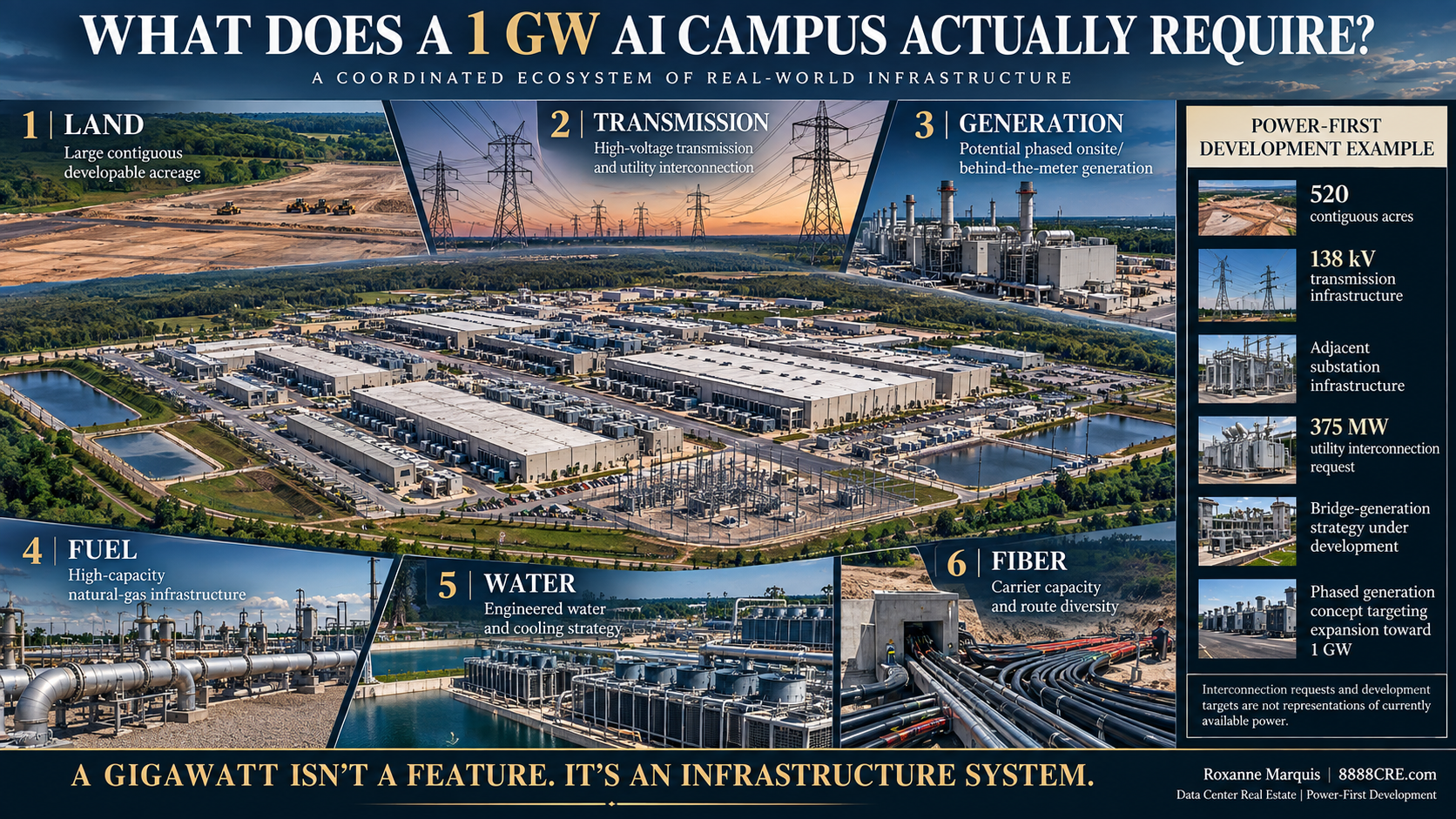
AI and hyperscale computing are changing data center site selection. As electrical loads increase, deliverable power, time to power, generation, fuel, water and infrastructure execution can reshape where large-scale data centers are developed.
AI and hyperscale power demand is changing how developers evaluate land, power, generation and infrastructure for large-scale Texas data centers.
DALLAS, TX, UNITED STATES, September 29, 2026 /EINPresswire.com/ -- Texas Data Center Site Selection Shifts Toward Power-First Development
Artificial intelligence is forcing the data center industry to confront a fundamental constraint: compute can be deployed faster than the infrastructure required to power it. As AI and high-performance computing campuses move from hundreds of megawatts toward gigawatt-scale development, time to power is becoming one of the defining considerations in data center site selection, large-load interconnection and digital infrastructure investment.
ERCOT reported in June that it was tracking more than 438 GW of large-load requests, with nearly 89% associated with data centers. The scale of prospective demand has led ERCOT and the Public Utility Commission of Texas to implement new processes for evaluating large loads and their potential effects on the transmission system.
The shift is creating an important distinction between transmission infrastructure and deliverable power.
A high-voltage transmission line near a development site can be an important infrastructure advantage, but its presence alone does not establish that hundreds of megawatts can be delivered on the schedule required by an AI or hyperscale customer.
For developers evaluating campuses requiring 250 MW, 500 MW, 1 GW or more, site selection increasingly involves a broader set of questions: how much power can actually be delivered, when it can be delivered, what transmission upgrades may be required, whether generation can be developed alongside the load, and how fuel, water and fiber infrastructure will support phased development.
"The definition of a data center site is changing," said Roxanne Marquis, founder of 8888CRE.com. "For very large AI and high-performance computing projects, land and power can no longer be evaluated independently. Developers increasingly have to understand the entire infrastructure system required to turn a site into operating compute capacity."
That change is contributing to increased interest in power-first development strategies.
Rather than beginning with land and addressing power later, a power-first approach evaluates land, utility interconnection, transmission, generation, fuel, water and fiber as interconnected components of the development strategy.
Utility-supplied electricity remains central to long-term data center development. However, onsite and behind-the-meter generation are increasingly being evaluated as potential components of phased power strategies while long-term utility infrastructure is developed.
ERCOT's current large-load framework recognizes configurations involving large loads that bring generation, including Withdrawal-Limited Private Use Networks. At the same time, Texas is increasing scrutiny of the broader effects of large data centers, including grid dependency, onsite generation, water consumption, cooling technology and community impacts.
These developments could also broaden the geographic boundaries traditionally used for data center site selection.
Established data center markets continue to offer significant advantages, including dense fiber networks, experienced contractors, existing customers and mature infrastructure ecosystems. But as individual projects reach hundreds of megawatts or more, access to scalable energy infrastructure can materially change the relative importance of geography.
As demand for powered land, power-ready land and large-scale powered sites increases, a site outside an established data center cluster may warrant consideration when contiguous acreage can be combined with transmission, grid capacity, generation potential, fuel infrastructure, water, fiber connectivity and an executable pathway to power.
For a large AI data center or hyperscale data center campus, site acquisition is increasingly only the beginning of the development process. A property may be shovel-ready from a traditional real estate perspective and still require substantial electrical infrastructure development before it can support high-density compute or GPU infrastructure. As a result, data center development and site development are becoming increasingly tied to power availability, time to power and time to market. The most consequential sites may be those where land, transmission capacity, power delivery, fiber diversity, cooling infrastructure and the broader development strategy can advance together.
"The question is no longer simply whether power infrastructure is near the property," Marquis said. "The more important question is whether the site provides a credible pathway to deliver the required power when the customer needs it."
At gigawatt data center scale, that analysis moves deeply into power systems engineering. Large-load interconnection can require transmission planning, load-flow analysis, power-flow studies, system-impact studies, short-circuit analysis and contingency analysis to understand whether the surrounding electrical system can reliably serve the proposed load. Questions involving N-1 reliability, substation and switchyard configuration, high-voltage transmission capacity and required network upgrades can determine whether apparent grid capacity ultimately becomes deliverable capacity.
In ERCOT, developers must also navigate the applicable ERCOT interconnection process, transmission service provider requirements and large-load study procedures, including a Large Load Interconnection Study, or LLIS, where applicable. The transmission service provider, or TSP, and ERCOT each have important roles in determining how a proposed large load interacts with the transmission system. Understanding those requirements early can materially affect site acquisition, infrastructure planning, development risk and project schedules.
The growing focus on speed to power is also expanding the role of power generation development in data center site selection. Depending on the project and regulatory structure, developers may evaluate bridge power, onsite power generation, behind-the-meter power, BTM generation, dispatchable generation, natural gas generation or other generation technologies alongside the long-term utility solution.
A Private Use Network, or PUN, may also become relevant to certain configurations. Each approach introduces its own engineering and commercial requirements, including gas pipeline capacity, generation equipment, electrical interconnection, grid reliability, emissions and permitting, fuel contracting and infrastructure execution. The objective is not simply to install gas-fired generation. It is to determine whether generation, transmission and utility power can form a credible phased power strategy that reduces development risk while accelerating the path to usable compute capacity.
The same standard increasingly applies to natural gas, water and fiber. Regional infrastructure should not be confused with infrastructure that has been engineered, contracted and demonstrated to be deliverable to a specific development.
Gas pipeline capacity must be evaluated against the requirements of proposed generation. Fiber connectivity must ultimately address capacity and fiber diversity. Water requirements depend substantially on the cooling infrastructure and technology selected for the campus. Each component can affect infrastructure execution, capital requirements and the schedule between site control and operating compute.
As power moves further upstream in data center site selection, the boundary between engineering and development is beginning to narrow. Some of the most consequential work can occur before a site becomes a project, when engineers, developers and real estate teams are still determining whether the physical and electrical infrastructure can support the intended load. That creates an unusually interesting position for power systems engineers, interconnection engineers and transmission planning engineers who are drawn to difficult, undefined problems and want to work closer to where opportunities originate. At this stage, technical insight can do more than engineer a solution; it can help identify opportunities, expose development risk and determine whether a viable project exists in the first place.
For hyperscalers, AI infrastructure companies and data center developers, the result may be a broader approach to site selection. AI compute and high-density GPU infrastructure do not eliminate traditional requirements for location, connectivity, workforce and development feasibility. They can, however, make the ability to assemble scalable power and infrastructure considerably more important when evaluating where the next hyperscale campus can be developed.
The shift may be equally consequential for capital.
For infrastructure investors, power-first development may create a distinct digital infrastructure investment opportunity before a data center reaches stabilized operation. As AI infrastructure drives unprecedented demand for electricity, the scarce asset is increasingly not land or generation alone, but the ability to combine land, deliverable power, transmission, generation, fuel, water, fiber and entitlements into infrastructure capable of supporting AI compute at scale.
That creates an opportunity for infrastructure capital, institutional capital, private infrastructure investment and development capital to participate earlier in the value-creation cycle, helping transform land and energy resources into phased, power-ready capacity capable of supporting hundreds of megawatts and potentially gigawatt-scale development.
For an infrastructure investor accustomed to acquiring completed real assets, the emerging data center investment opportunity may increasingly extend upstream into infrastructure development itself, where capital deployment can help create the power and digital infrastructure that future AI campuses require before vertical construction can begin.
The result is a new convergence among the data center site selection executive searching for the next campus, the data center power executive responsible for delivering its energy, the power systems and interconnection engineers determining whether the infrastructure will work, the power developers building generation solutions and the infrastructure investors providing the capital required to build it.
The next generation of Texas data center development may therefore be determined less by where data centers have historically clustered and more by where land, power and supporting infrastructure can be assembled into scalable operating capacity.
For the AI infrastructure market, the question is becoming increasingly straightforward:
Not simply, "Where is the power?"
But, "Where can power actually be delivered, at scale, on the timeline required to turn land into compute?"
About the Author
Roxanne Marquis is a commercial real estate broker and founder of 8888CRE.com, specializing in assembly of the teams required for data center land, power-advantaged real estate and digital infrastructure development. Her work focuses on the intersection of land, power, infrastructure and site selection for large-scale AI, hyperscale and high-performance computing development.
Through 8888CRE.com, Marquis works with landowners, developers, investors, capital groups, and infrastructure companies to identify and position sites capable of supporting the next generation of power-intensive development.
Data Center Site Selection and Development Opportunities
8888CRE works with data center developers, hyperscalers, AI infrastructure companies, investors and landowners on large-scale data center and digital infrastructure opportunities.
For information about available data center sites, power-advantaged development opportunities or site-selection requirements, contact:
Roxanne Marquis
Texas Broker #0688184
8888CRE.com
rose@8888cre.com
+1 972-805-7587
Visit 8888CRE.com for data center site opportunities, market intelligence and analysis of power-first digital infrastructure development.
Roxanne Marquis
8888CRE.com
+ +1 9728057587
email us here
Visit us on social media:
LinkedIn
Facebook
YouTube
X
Other
North Texas 3 GW AI Data Center Campus | Transmission-Scale Power Platform
Legal Disclaimer:
EIN Presswire provides this news content "as is" without warranty of any kind. We do not accept any responsibility or liability for the accuracy, content, images, videos, licenses, completeness, legality, or reliability of the information contained in this article. If you have any complaints or copyright issues related to this article, kindly contact the author above.
