

Puntt AI Survey Finds Approval Bottlenecks, Not Manufacturing, Are Primary Barrier to CPG Product Launches
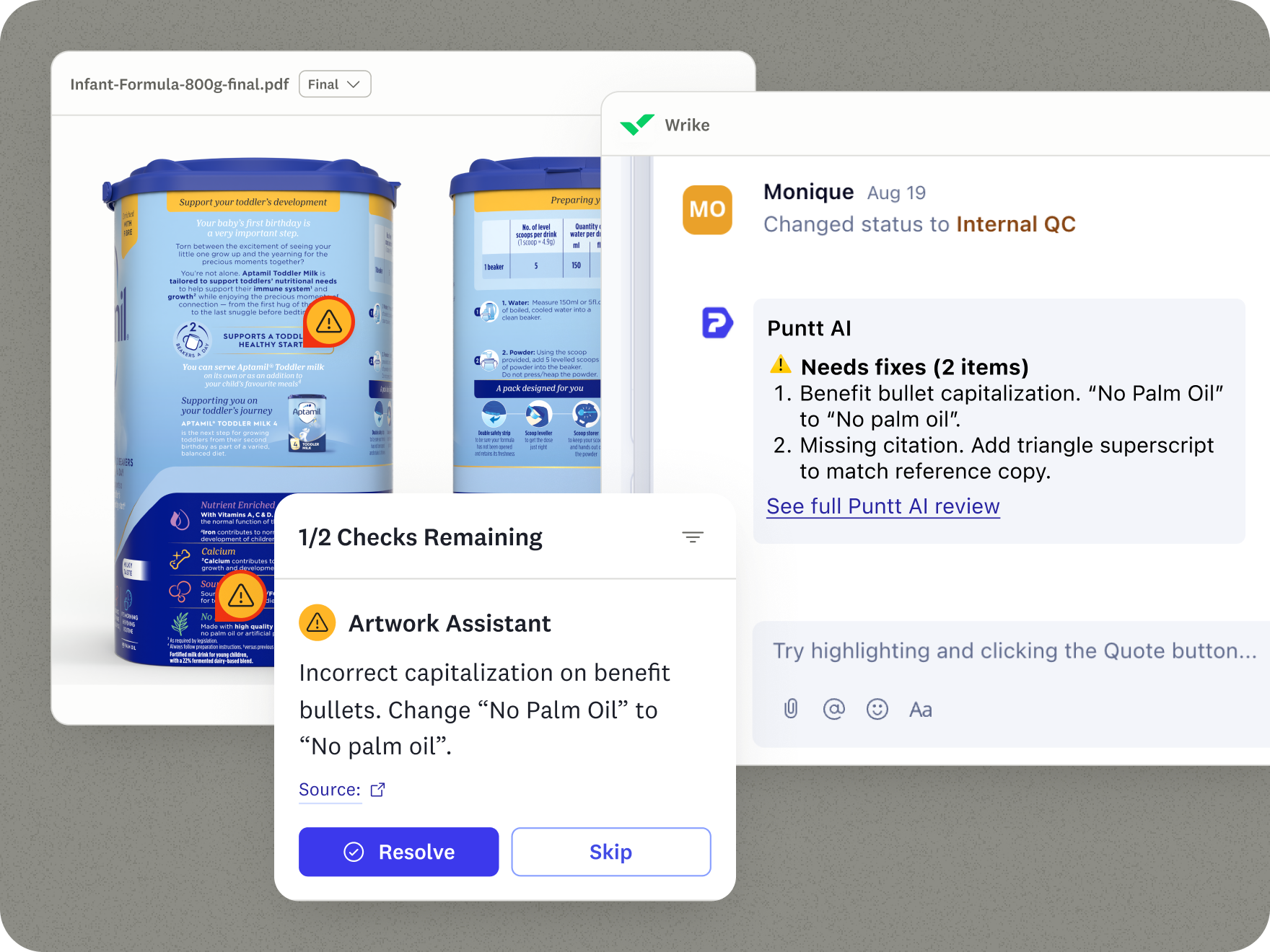
Tools like Puntt AI's review agent can expedite regulatory review
New Study of 107 Enterprise Executives Examines How Manual Processes Impact CPG Product Launch Timelines
SAN FRANCISCO, CA, UNITED STATES, March 18, 2026 /EINPresswire.com/ -- Manual compliance workflows are creating significant bottlenecks for Consumer Packaged Goods (CPG) companies, according to a new survey of 107 enterprise compliance and marketing executives released today by Puntt AI. The study finds that approval capacity, not manufacturing or technical constraints, has become the primary factor slowing speed to market in regulated industries.Key Survey Findings:
Time-to-Market Impact: 89% of regulated companies say review capacity, not technical or manufacturing limits, is what slows their speed to market. Minor packaging or label changes add 4-8 weeks to launch timelines due to review backlogs and manual rework, while approval cycles stretch to 6-18 months as sequential workflows force teams to wait for each function before proceeding.
Resource Misallocation: 73% of companies dedicate entire offshore teams to manual verification tasks that automated systems could handle. Meanwhile, 94% of legal and regulatory teams require full manual re-verification of elements that haven't changed, forcing teams to repeat identical checks hundreds of times per year.
Global Complexity: 78% of companies selling in multiple markets report multi-day regulatory review cycles for each formula change across 40+ jurisdictions, while 81% maintain manually updated compliance databases that go out of date within weeks.
Enterprise Technology Barriers: 67% of companies investing in enterprise infrastructure resist point solutions that don't show clear adaptability to existing ERP systems, PIMs, and custom workflows.
The Redundancy Problem
According to the survey, when a single element changes on packaging — an address update, a minor ingredient swap, or a regulatory requirement — the entire approval process restarts from scratch.
"When a small change in an ingredient, a regulatory requirement, or a claim triggers the need to change an artwork, approval templates need to be re-opened," said Gonzalo Balcazar, SVP at Reckitt. "For most organizations, these reopened templates need to be fully verified and approved again by regulatory and legal functions even if most of the elements remain unchanged. Organizations are currently paying teams to repeat identical checks that could be easily automated."
This pattern repeats hundreds of times per year across product portfolios. Teams can't differentiate between "what's new and needs expert judgment" versus "what's identical and could be pre-approved."
Sequential Workflows and Approval Cycle Timelines
The survey finds that compliance delays stem from sequential workflows where creative waits for brand, brand waits for regulatory, and regulatory waits for R&D. When one element changes anywhere in the chain, the entire cycle restarts.
"The 6-18 month approval cycles aren't because teams are slow. They're because decisions move sequentially," said Ronnie Kwesi Coleman, CEO of Puntt AI. "Creative waits for Brand. Brand waits for Regulatory. Regulatory waits for R&D. Then one change triggers full re-review of everything — and the cycle restarts. What changes with AI isn't just speed. It's the ability to run all those checks in parallel across 40 markets. You're not asking people to take more risk. You're giving them better information to make the same decisions, just faster."
In industries where seasonal launches and timing windows determine market success, survey respondents reported that these bottlenecks have direct competitive consequences, with companies citing delayed time-to-market as a primary business impact.
Survey Methodology
The survey was conducted among 107 compliance and marketing executives at enterprise CPG companies with global operations in regulated industries including food and beverage, consumer health, and beauty, .
About Puntt AI
Puntt AI is the review automation platform for regulated enterprise brands. Its AI-powered technology automatically reviews marketing and packaging assets for brand, regulatory, and legal compliance — inside tools teams already use, including Wrike, Asana, Figma, and Adobe Creative Cloud. Trusted by 120+ enterprise brands including Danone, Nestlé, Kenvue, and Indeed, Puntt has automated more than 374,000 hours of manual reviews and reduced rework by 40% within the first 90 days of deployment. Headquartered in San Francisco. Learn more at puntt.ai.
John Rich
Puntt AI
email us here
Visit us on social media:
LinkedIn
Legal Disclaimer:
EIN Presswire provides this news content "as is" without warranty of any kind. We do not accept any responsibility or liability for the accuracy, content, images, videos, licenses, completeness, legality, or reliability of the information contained in this article. If you have any complaints or copyright issues related to this article, kindly contact the author above.
